

E-2 Treaty Investor Visa
U.S. Work Authorization Built Around Your Investment
The E-2 treaty investor visa allows nationals of qualifying countries to live and work in the United States by investing in and directing a U.S. business. It is one of the most practical pathways for European entrepreneurs, investors, and founders who want to establish or expand operations in the U.S. market — without the timelines or complexity of immigrant visa categories.
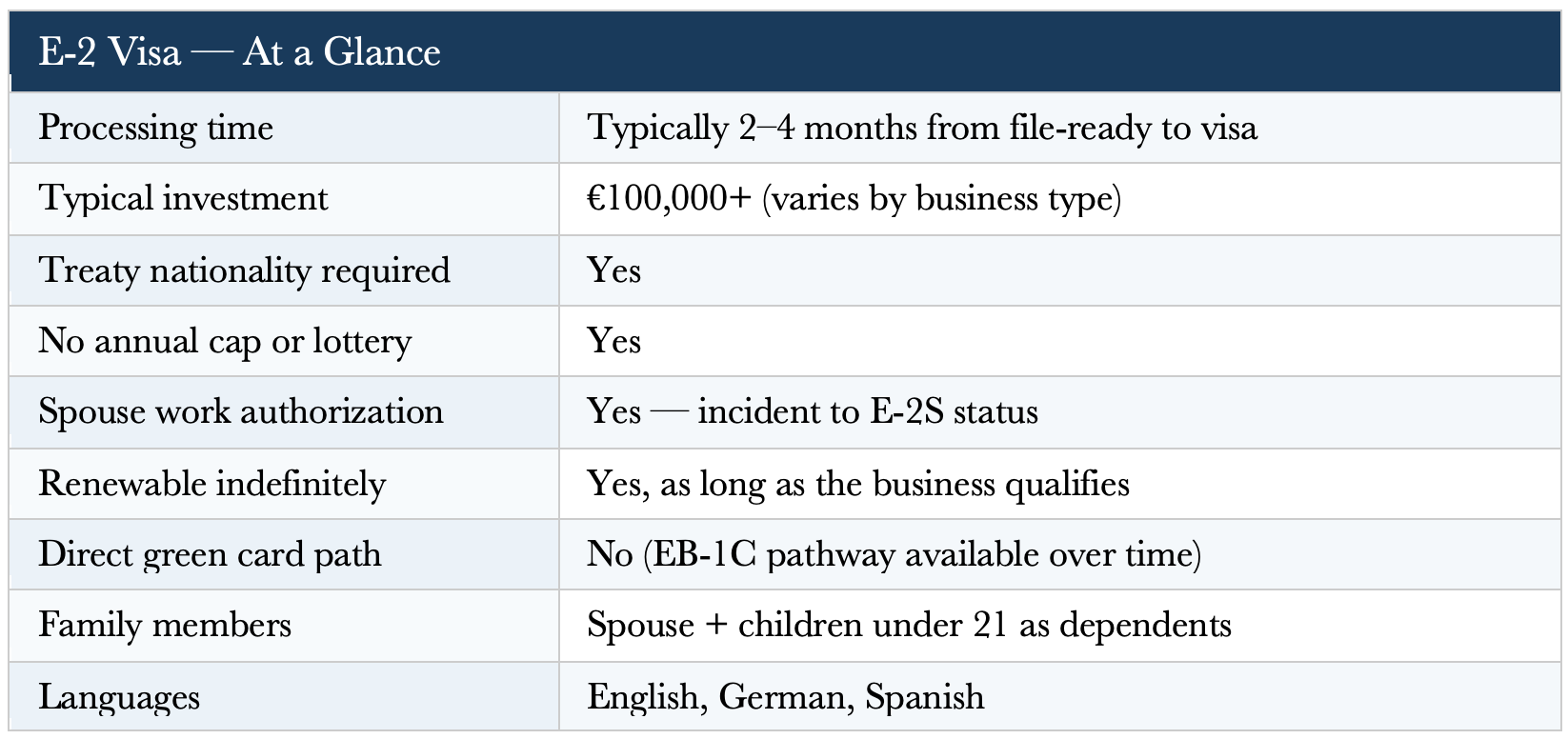
There is no annual cap on E-2 visas. No lottery. Processing through U.S. consulates in Europe is typically faster than most other business visa routes.
What Is the E-2 Visa?
The E-2 treaty investor visa is a U.S. nonimmigrant visa that authorizes a foreign national to enter and work in the United States based on a qualifying investment in a real, active U.S. business. The investor must own and direct the enterprise — it is not available to passive investors.
Unlike the H-1B, the E-2 is not subject to an annual cap or a lottery. Unlike the EB-5, it does not require a minimum investment of $800,000 or a multi-year wait for permanent residence processing. For European founders and business owners seeking U.S. market access, the E-2 is often one of the fastest and most practical routes to authorized U.S. operations.
Why European Founders Choose the E-2 Visa
European entrepreneurs and investors choose the E-2 visa for several reasons that are specific to their situations:
• No lottery, no cap. The E-2 visa is not subject to annual numerical limits. There is no H-1B-style lottery, and applications are not queued behind thousands of other petitions.
• Operational control. The E-2 requires that you direct the enterprise. You are building and running a U.S. business — not waiting for an employer to sponsor you.
• Speed. For clients applying through U.S. embassies in Vienna, Berlin, Frankfurt, Bern, or Madrid, consular processing is typically faster than USCIS-based routes for comparable visa categories.
• Flexibility. The E-2 works for new businesses, acquired businesses, franchises, and U.S. expansions of existing European companies. It accommodates a wide range of investment sizes and business models.
• Compatible with Delaware structures. E-2 applications work well with Delaware C-Corp and LLC formations — the standard structure for U.S. market entry by European founders. Entity formation and visa planning must be coordinated from the outset to ensure consistency across filings.
• A platform for long-term status. E-2 visas can be renewed indefinitely as long as the business remains active and qualifying. Investors who build their U.S. operations over time may also become eligible for the EB-1C green card pathway.
• Family relocation. Your spouse and children can accompany you. E-2 spouses are work-authorized incident to status.
Who the E-2 Visa Is For
The E-2 visa is designed for investors who are actively building and directing a U.S. business. It is appropriate for:
• Entrepreneurs making a direct investment in a new U.S. business
• European founders expanding an existing company into the U.S. market
• Buyers acquiring an established U.S. business or franchise
• Business owners who need U.S. work authorization tied to active ownership and management
Who the E-2 Visa Is Not For
The E-2 is not appropriate for every situation. It will not work for:
• Passive investors who do not intend to actively direct U.S. operations
• Applicants whose investment is too small relative to the cost of the enterprise
• Speculative or undeveloped business concepts without committed capital
• Individuals seeking U.S. employment sponsorship from a third-party employer
• Real estate investors whose holdings are passive and not part of an active operating enterprise
• Nationals of countries that do not maintain an E-2 treaty with the United States
If your situation fits one of the above categories, a different pathway may be more appropriate. A case assessment will identify the right options.
E-2 Treaty Countries
To apply for the E-2 visa, you must hold citizenship of a country that maintains a qualifying treaty with the United States. Austria, Germany, Switzerland, and Spain all qualify. So do most other European nations.
Citizenship — not residency — determines eligibility. If you hold citizenship in a qualifying treaty country but currently reside elsewhere, you may still be eligible to apply.
E-2 Visa Requirements
Treaty Nationality
You must be a national of an E-2 treaty country. For corporate applicants, at least 50% of the business must be owned by nationals of the same treaty country.
Substantial Investment
You must have invested, or be actively in the process of investing, a substantial amount of capital in a real U.S. enterprise. The E-2 visa has no fixed minimum investment amount — the standard is proportionality. The investment must be sufficient to ensure the successful operation of the business.
In practice, investments below €80,000–€100,000 face heightened scrutiny, particularly for asset-light or service businesses. Capital-intensive businesses — manufacturing, hospitality, logistics — may require significantly more to meet the standard. The critical question is whether the amount is proportionate to the total cost of the enterprise and demonstrates a genuine commercial commitment.
Funds must be irrevocably committed at the time of application — meaning invested or contractually obligated. Funds sitting in a personal account without commitment do not qualify.
At-Risk Capital
The invested capital must be subject to commercial risk. You cannot protect or guarantee the investment against loss as a condition of the visa. Funds held in escrow pending visa approval are an accepted approach — they are treated as committed even before disbursement to the seller or business.
Non-Marginality
The business must be capable of generating significantly more than a subsistence-level income for the investor. A business that exists solely to support the investor and their family will not qualify. Consular officers and USCIS adjudicators look for evidence of employees, contracts, physical premises, and a credible growth trajectory.
Direct and Develop Requirement
The E-2 visa requires that you come to the United States to develop and direct the business. You must own at least 50% of the enterprise, or alternatively hold a position of genuine operational control. The E-2 is not available to passive investors.
E-2 Business Plans
For most E-2 applications, the business plan is one of the most consequential documents in the file. Consular officers use it to evaluate whether the investment is credible, the business is viable, and the enterprise will generate meaningful economic activity beyond supporting the investor.
A well-drafted E-2 business plan addresses:
• The nature of the business and the market it operates in
• Investment breakdown and source of funds
• Revenue projections with supporting assumptions
• U.S. job creation timeline
• The investor's operational role and qualifications
• How the business meets the non-marginality standard
A generic business plan drafted without legal input creates unnecessary risk. The plan must be written with the adjudicatory standard in mind — not just as a commercial document.
Business plan drafting is available as a standalone service or as part of full E-2 representation.
E-2 Visa Process
Every E-2 matter is handled as a coordinated business and immigration project — not merely a visa filing. Entity formation, ownership structure, capitalization, source of funds, and immigration strategy must align from the outset.
Step 1 — Case Assessment and Strategy: Review of your investment structure, ownership, business type, and capitalization to confirm E-2 eligibility and identify any issues before preparation begins.
Step 2 — Entity Formation (If Needed): If you do not yet have a U.S. entity, formation of your Delaware C-Corp or LLC is coordinated before or alongside visa preparation. The entity documentation and immigration filings must be consistent.
Step 3 — Document Preparation: Assembly of the full evidentiary package: investment documentation, source of funds, organizational documents, business plan, evidence of premises and operations, and personal supporting materials.
Step 4 — DS-160 and Consular Filing: Preparation and submission of the DS-160 nonimmigrant visa application and supporting materials to the relevant U.S. Embassy or Consulate.
Step 5 — Consular Interview Preparation: Preparation for the interview at the relevant U.S. consulate. For clients in Austria: U.S. Embassy Vienna. Germany: Berlin or Frankfurt. Switzerland: Bern. Spain: Madrid.
Step 6 — Visa Issuance and U.S. Entry: Upon approval, the E-2 visa is affixed to your passport. Initial admission at a U.S. port of entry is typically for two years, with the ability to extend status as long as the business qualifies.
E-2 Visa Timeline
From engagement to a file-ready application, most E-2 cases are prepared within 8 to 14 weeks depending on document availability and business complexity. Consular appointment scheduling varies by location and season.
There is no USCIS premium processing option for consular E-2 filings. For change-of-status filings made from within the United States, premium processing may be available depending on the specific filing route. Consular processing at major European posts is generally faster than USCIS-based routes for comparable visa categories.
E-2 Visa Renewal and Long-Term Strategy
The E-2 visa has no statutory limit on renewals. As long as the business remains active, operational, and qualifying, status can be extended indefinitely. Extensions are typically granted in two-year increments for status purposes, with the visa stamp itself valid for up to five years depending on the bilateral treaty with your country.
EB-1C: The Green Card Pathway for E-2 Investors
The E-2 visa does not lead directly to a green card. However, E-2 investors who develop their U.S. operations and hold executive or managerial roles may become eligible for the EB-1C immigrant visa — the Multinational Executive or Manager category. The EB-1C requires no labor certification and is one of the most efficient green card pathways available to business owners.
Structuring for EB-1C eligibility from the outset of an E-2 investment — through role definition, organizational structure, and documentation — significantly improves long-term outcomes. This is a planning issue, not an afterthought
E-2 Visa for Families
Your spouse and unmarried children under 21 may accompany you to the United States as E-2 dependents. They do not need to share your treaty nationality.
E-2 spouses are generally work-authorized incident to status under E-2S classification and may also obtain an Employment Authorization Document for ease of onboarding with U.S. employers. Dependent children may attend U.S. schools while in E-2 status.
E-2 vs. L-1 Visa
Both the E-2 and L-1 visas provide U.S. work authorization for business owners and executives. The right choice depends on your specific circumstances. The table below outlines the key differences.
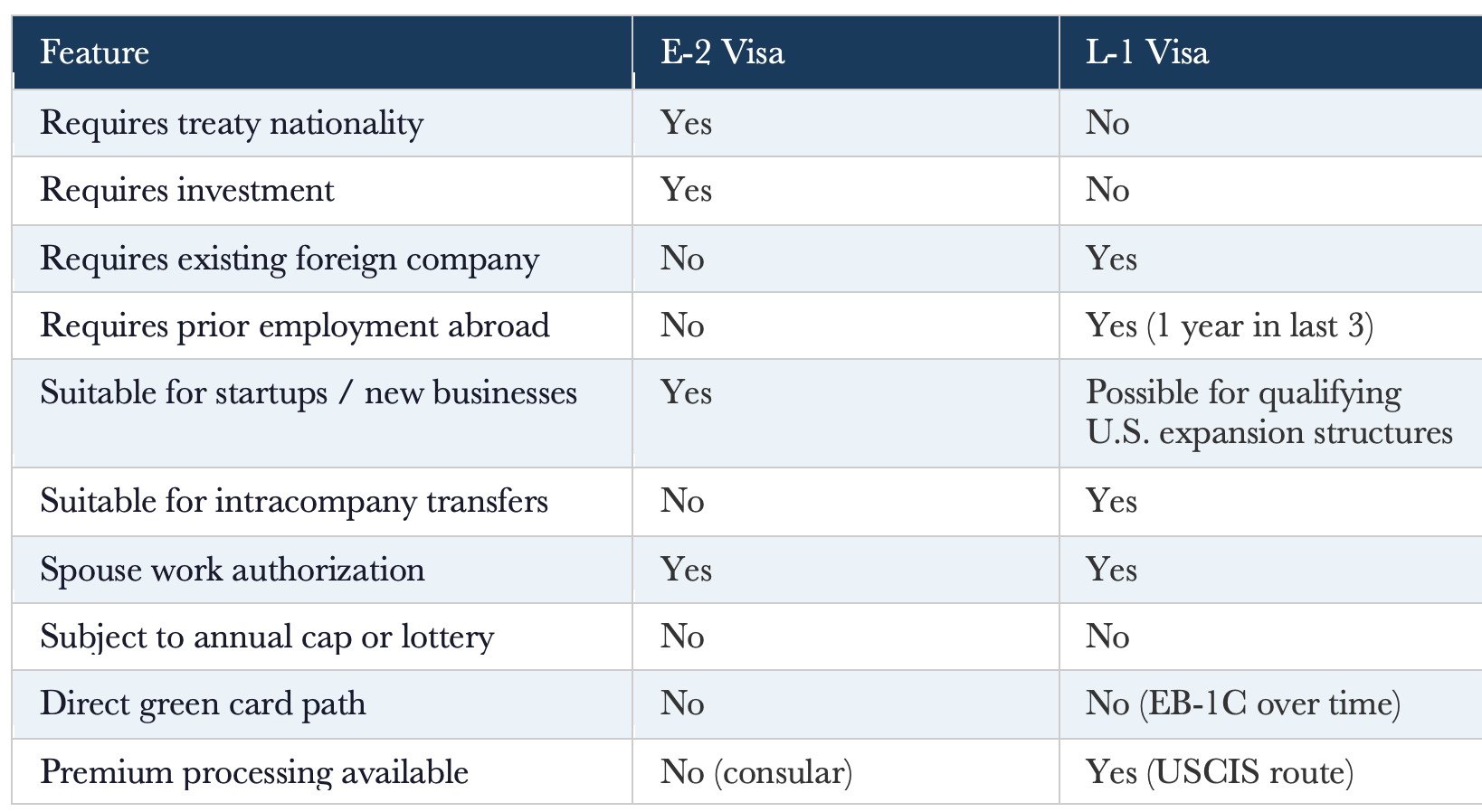
In some cases both pathways are available and the choice is strategic. A case assessment will identify which is more appropriate given your structure and objectives.
Fees
E-2 Treaty Investor Visa — €10,400
E-2 + Delaware Entity Formation Bundle — €12,100 (saves €1,000 vs. combined standalone pricing)
Additional services:
• Business plan drafting — €2,500
• Dependents (each) — €650
• RFE response — €1,300
• EB-1C transition strategy memo — €1,500
Government filing fees are not included and vary by consulate and individual circumstances. All matters are handled on a fixed-fee basis — no hourly billing, no unexpected charges.
Frequently Asked Questions
-
No fixed minimum is set by regulation. The standard is proportionality — the investment must be substantial relative to the total cost of the enterprise. In practice, cases below €80,000–€100,000 face closer scrutiny. Higher-cost businesses require proportionally larger investments.
-
Partially. Loans secured by the assets of the U.S. business itself do not qualify — the funds must be at personal risk. Loans secured by your own personal assets can qualify, as the risk falls on you.
-
Not directly. The E-2 is a nonimmigrant visa with no direct immigrant pathway. However, E-2 investors who develop their operations and hold executive or managerial roles may qualify for the EB-1C green card over time. Planning for this from the outset makes a significant difference.
-
You can apply with a start-up business. The investment must be committed and the enterprise sufficiently established to demonstrate it is real and not speculative. Pre-opening expenses, signed leases, purchased equipment, and capitalized accounts all support the application.
-
Yes. E-2 spouses are generally work-authorized incident to status under E-2S classification. They may also obtain an Employment Authorization Document, which can simplify onboarding with U.S. employers.
-
Initial admission is typically for two years. Status can be extended indefinitely as long as the business qualifies. The visa stamp is valid for up to five years depending on the bilateral agreement with your treaty country.
-
If you are currently in the U.S. in valid nonimmigrant status, you may file a change of status with USCIS rather than applying at a consulate. This avoids departure for an interview but has its own procedural and timing considerations.
-
There is no fixed minimum physical presence requirement, but you must be genuinely directing the business. Extended absences without operational justification can raise questions at the border or during renewal.
-
The EB-5 is an immigrant visa requiring a minimum investment of $800,000 (in targeted employment areas) or $1,050,000 and creation of at least 10 U.S. jobs. It leads directly to a green card but involves lengthy processing times. The E-2 has no fixed minimum investment, is faster, and does not require job creation commitments of that scale — but it does not lead directly to permanent residence.
Work With Valstone
I am a New York-licensed U.S. immigration attorney based in Vienna, Austria. My practice focuses exclusively on U.S. business and immigration law for European clients. I handle E-2 cases directly — no delegation, no case managers. Clients communicate with me in English, German, or Spanish throughout the engagement.
Every E-2 matter at Valstone is handled as a coordinated project: entity structure, investment documentation, business plan, and immigration filing treated as a unified case, not a series of disconnected tasks.
If you are planning a U.S. investment or expansion and want to assess whether your structure qualifies for E-2 status, schedule a consultation to discuss strategy, eligibility, and next steps.